
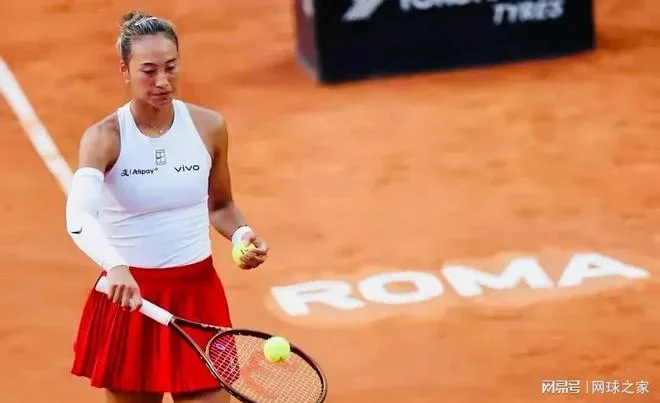
As the Rome 1000 main draw approaches, the latest WTA rankings have added to the challenges facing China’s second-ranked female tennis player, Zheng Qinwen.
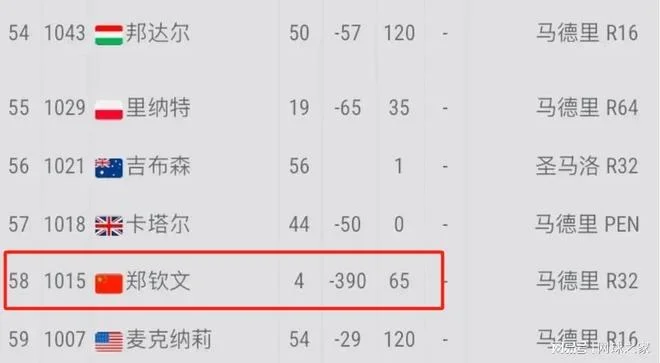
It was widely expected that Zheng’s ranking would drop after her 390 points from last year’s Rome quarterfinal run were deducted. However, the extent of the fall was surprising. Her ranking plummeted from No. 36 to No. 58, pushing her out of the top 50.
This means Zheng now faces increased pressure to halt the slide. Starting with the Rome 1000, she must rely on pure strength to battle every opponent.
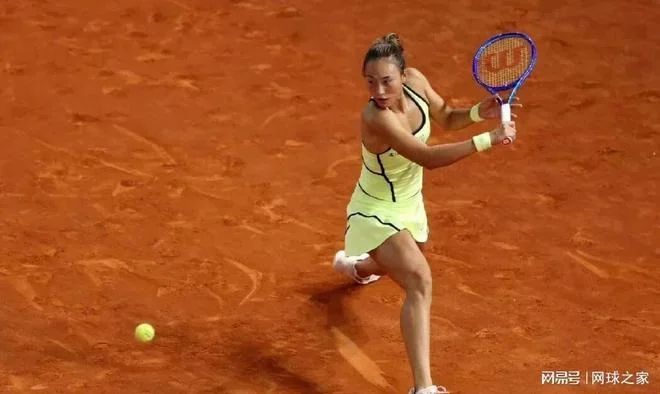
Another hurdle is that Zheng has been excluded from the top 32 seeds in this year’s Rome event, losing the first-round bye. She will have to fight from the opening round.
Reactions from the tennis community have been mixed. Some say this is a real test for Zheng, requiring her to stay fully focused to avoid an early exit. Others believe starting from the first round could help her better adapt to the clay courts in Rome, potentially leading to a deeper run.
However, the Rome draw presents a tough first opponent in Bondar. The Hungarian is known as a “grinder” on the women’s tour. In Madrid, Bondar pushed Andreeva to a grueling 2-hour-53-minute match, nearly toppling the world top 10. Moreover, when Zheng faced Bondar in Rome 2023, she struggled against her moonball tactics and barely escaped with a win.
The concern is that Zheng, still recovering from a break, must show exceptional patience and minimize errors against Bondar’s solid form and endurance. Zheng herself has repeatedly mentioned that she hasn’t yet found her rhythm, making this issue especially critical.
Even if Zheng gets past the first two rounds, a potential third-round clash with Anisimova and a quarterfinal showdown with Sabalenka loom large, vastly increasing the difficulty. Matching last year’s semifinal result in Rome seems a formidable task.
Now ranked 58th, Zheng’s performance in Rome will directly influence her fate at the French Open, as noted by a fan. Without a seeded spot in Rome, the French Open will be even more challenging. Last year, Zheng reached an historic quarterfinal in Paris. If she exits early in Rome and fails to match that result in Paris, the road ahead could become even tougher.
Expectations for Zheng’s Rome campaign are therefore modest. Some observers believe that simply getting past Anisimova would be a significant success, and the immediate priority is to stop the ranking freefall.
Encouragingly, despite the unfavorable draw and ranking decline, Zheng remains confident. Speaking in Rome after recalling her first victory over Sabalenka on this same clay court, Zheng said, “She is always excellent. Every practice with her gives me a different feeling. She is one of the few who can handle my ball. When I train with other players, I feel the gap in ball quality is quite big.”
When asked about tournament selection, Zheng said she prefers higher-level events to “understand what’s missing to win against the top players and see where my tennis stands.” This comment has eased concerns about her tough draw, as it shows she is mentally prepared to compete with the best, believing that true strength outweighs the luck of the draw.